Sculpting Leggings for Women and the Squat Test
The squat test is usually performed in the worst possible conditions: changing-room light, a shallow bend, a quick glance, a decision made in thirty seconds. Then the real test arrives later, in a bright studio, at full depth, in front of a mirror you did not choose. Sculpting leggings for women are often bought to settle exactly that worry, so it is worth being precise about what sculpt construction can do — and what no construction can honestly promise without a stated coverage claim.
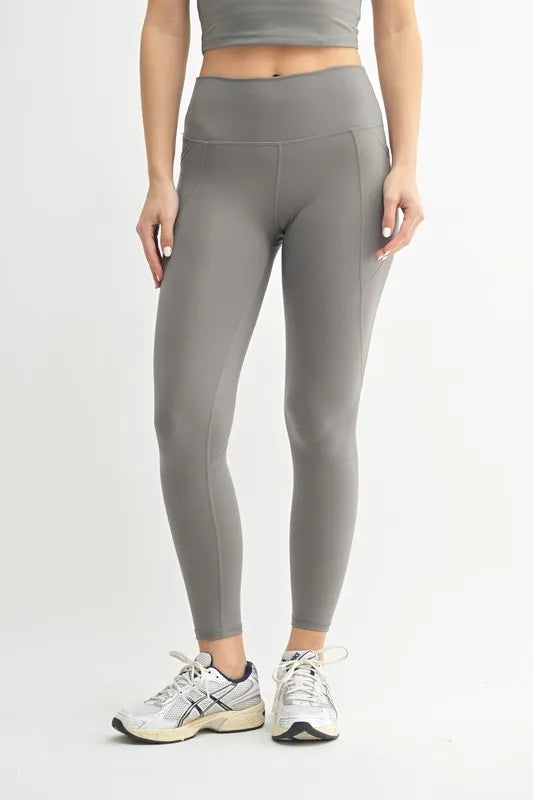
Our example is the Cloud Light Sculpt High-Waisted Leggings in New Pewter: 76% polyester and 24% spandex, high-waisted with tummy control, moisture-wicking and breathable, for $54.95. We chose the grey-toned colourway for this topic deliberately. Pewter sits between black and a pale pastel, which makes it a fair middle case for a coverage conversation.
The Short Answer
Sculpt construction shapes fit through a high waist, tummy control, and a stretch blend, but only a stated opacity claim settles squat coverage. The Cloud Light Sculpt Leggings in New Pewter from Anaraa, 76% polyester and 24% spandex, state no opacity claim, so test before training, for $54.95.

The squat-opacity problem, named properly
Opacity fails at maximum stretch. Standing still, almost every legging looks solid. At the bottom of a deep squat or hinge, the fabric over the seat and hip is stretched to its widest point in normal wear, and that is where thinness shows if it is going to show anywhere. Colour plays a part too: very light shades tend to reveal more under stretch than deep shades, with mid tones like this pewter grey in between.
Leggings have carried this tension since they moved from layered wear into standalone practice and gym clothing — the history of leggings follows that move from under-layer to outer garment. A garment worn as the outer layer is held to an outer layer's standard. That standard is reasonable. It just has to be tested under outer-layer conditions: full depth, bright light, no hurry.
What sculpt construction does about it
Sculpt, in this listing, is a fit story before it is a coverage story. The stated details work like this:
- High waist: more fabric coverage over the hip and waist, and an anchor point that keeps the legging positioned as you move into depth, rather than migrating downward.
- Tummy control: a smoothing hold at the midsection. It shapes how the waist area sits; it is not, by itself, a claim about fabric thickness through the leg.
- 24% spandex in a 76% polyester blend: a high elastic share means the fabric stretches substantially and recovers. Stretch is necessary for a deep squat — and it is also the moment opacity is tested, which is why the two ideas belong in the same conversation.
- Moisture-wicking and breathable: stated comfort features for training. They affect how the legging feels at depth and after it; they do not settle how it looks at depth.
Read that list again and notice what is absent. The listing for this product does not use the word opaque. A neighbouring pair in the same collection does state opacity plainly — our fabric explainer on wide waistband leggings with a stated opaque finish covers that pair, and the contrast is instructive. When a listing states a coverage claim, you can hold it to that claim. When it does not, the honest move is to test, not to assume.
Featured in this article
Cloud Light Sculpt High-Waisted Leggings — New Pewter
76% polyester, 24% spandex, high-waisted with tummy control, moisture-wicking and breathable. No opacity claim is stated in the listing.
$54.95 · View product
How to run a fair test, and the honest limit
Test any sculpt legging the way a class will. Put it on in the brightest light available to you. Squat to your real training depth, hinge fully, and check the seat and hip in a mirror — or ask someone whose judgement you trust. Do it before the first session, while returning or exchanging is still a simple decision. Thirty honest seconds at home beats a semester of self-conscious classes.
The honest limit of this article is the honest limit of the product facts: we cannot tell you this pair passes that test, because the listing does not state opacity and we do not invent claims to close a sale. What we can tell you is that New Pewter is a mid tone rather than a pale one, that the sculpt construction is aimed at fit and position, and that the stated blend and features are consistent with a training legging. The coverage verdict is yours to reach, with the test above.
If shifting and adjusting are your bigger frustration, our piece on contoured gym leggings and the adjusting problem tackles that side of fit. And on days when coverage anxiety is reason enough to choose drape over a close fit, our travel piece on flowy harem pants for restorative practice covers a silhouette where the question never arises.
“When a listing states a coverage claim, you can hold it to that claim. When it does not, test — do not assume.”
A fair verdict on sculpt and coverage
Sculpt construction earns its name on fit: a high waist that stays positioned, tummy control at the midsection, and a stretch blend that moves into depth and recovers. Coverage is a separate question, and for the New Pewter pair it is a question the listing leaves open. Buy it for the fit story if that story suits your training, and run the squat test early and honestly. You can see the rest of the range in our Leggings collection.
Questions, answered
Are the New Pewter Cloud Light Sculpt Leggings squat-proof?
The listing does not state squat-proof or opaque coverage, so we do not claim either. The stated features are tummy control, a high waist, moisture-wicking, and breathability, in a 76% polyester, 24% spandex blend.
What does sculpt mean in this legging?
In this listing, sculpt describes the fit construction: a high waist, tummy control at the midsection, and a cloud-light fabric with a high spandex share for stretch and recovery. It is a fit description, not a stated coverage guarantee.
How should I test leggings for opacity?
Use bright light, squat and hinge to your real training depth, and check the seat and hip where fabric stretches most. Do it before the first session, while a return or exchange is still straightforward.
More in this category
Leggings to consider next


Written by Abhay Paliwal